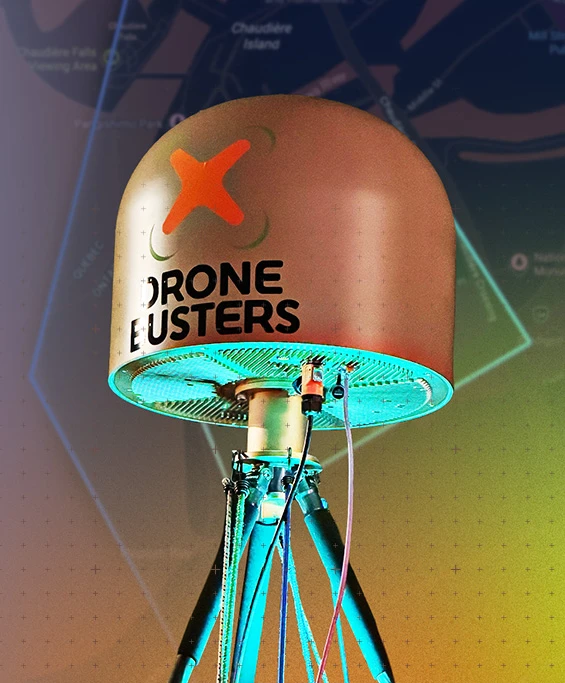


Know What's In Your Airspace - And Who Put It There
Unauthorized drones are a routine problem at outdoor events. Some are hobbyists who don't know the rules. Some are filming a set they have no rights to. A few have worse intentions. From the ground, they all look the same - and by the time someone on your team points at the sky, the drone has usually already done whatever it came to do.
Drone detection closes that gap. We find the aircraft, identify it, and locate the person flying it, while it's still in the air.
What detection gives you
The aircraft. Exact GPS position, altitude, speed, and direction of travel, updated live on a map of your site. Make and model, not just a contact on a screen - the system recognizes 99% of commercially available drones.
The operator. Where the pilot is standing, accurate to within a metre. This is what turns information into action. Your security team or local police go to a specific person in a specific place.
Advance warning. In most cases the drone appears before it takes off. If someone powers up a controller in your parking lot, you know while they're still unfolding the props.
A record. Every detection is logged: flight paths, timestamps, and operator positions. Retained at least 30 days and available to you for a police report, an insurance claim, or a conversation with a promoter.
Detection, not interference
We don't jam, disable, or bring down drones.
That's deliberate. Interfering with an aircraft in flight carries legal exposure, and it isn't something you want attached to your event. What you need is accurate information fast enough to act on - where the drone is, what it's doing, and where to find the person responsible. That's what we provide, and it's what lets your team and local authorities handle the situation properly.
Built for live events
Most drone detection is sold to airports, military installations, and government facilities - permanent infrastructure, permanent airspace, and permanent staff.
An event is none of those things. Your site exists for four days. Your perimeter is fencing. Your command structure is assembled the week before. The RF environment is unlike anything a fixed installation deals with, and the tall temporary structures, stages or delay towers, create hazards a drone pilot isn't expecting.
We come at this from twenty years inside festivals. The system deploys in 15 to 30 minutes, runs on site power or battery, connects over its own cellular, and leaves when you do.
Where it fits
Detection sits alongside what you already have. It doesn't replace your security contractor, your safety plan, or your emergency procedures - it adds the one layer most events are missing entirely.
For a lot of organizers, the first conversation happens because an artist's contract requires it, or an insurer asked, or a municipality wants to know the plan. If that's where you are, tell us about your event and we'll tell you straight whether it's a fit.